Introduction
When you ask ChatGPT or Claude to make an app or UI and say "make it look good," the result often comes back with a safe color palette that feels like something you have already seen.
The same thing happens when making slides in PowerPoint or writing a report in Word. Before thinking about the actual content, you can get stuck on "what colors should I use?" For people who are not design specialists, choosing colors remains a stubborn bottleneck.
I built Morphos to skip that problem entirely.
Portfolio: Projects / Morphos
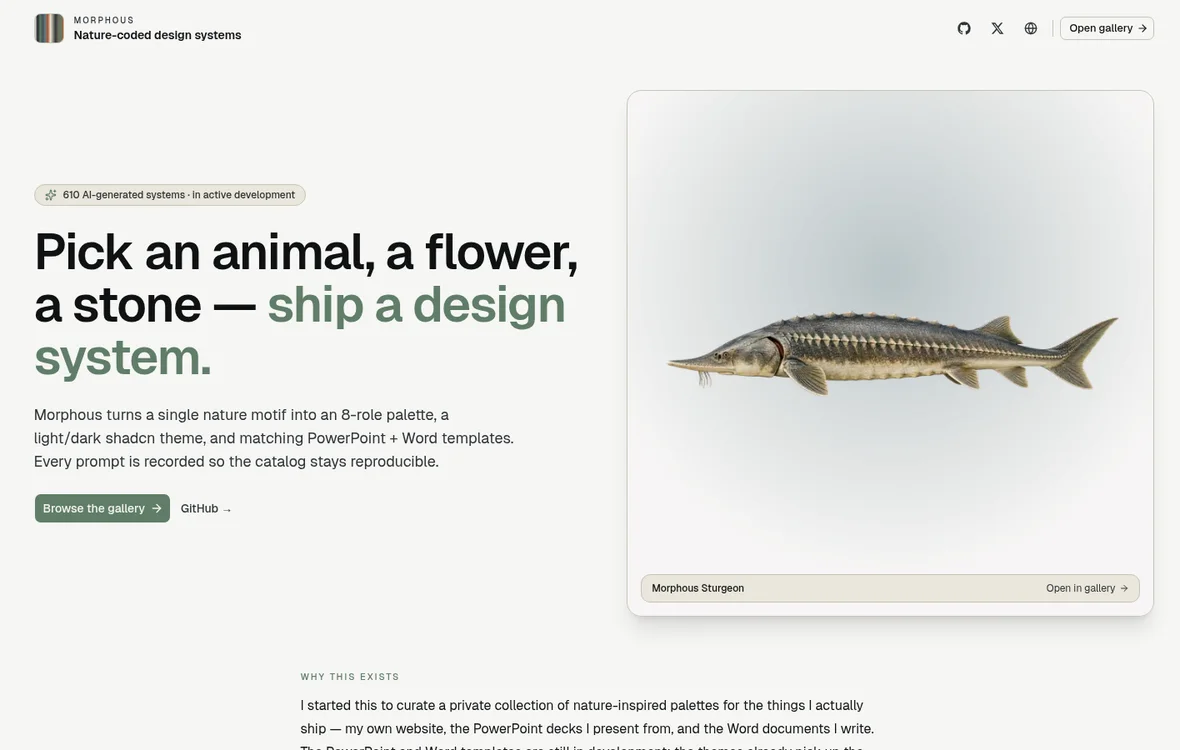 Morphos home screen, showing the path from a nature motif to a ready-to-use design system.
What Morphos Is
Morphos is a collection site for color palettes and design systems based on motifs from the natural world.
Butterfly wings, minerals, the deep sea, moss, sunsets, bird feathers. Nature is already a vast archive of color systems refined over hundreds of millions of years. Morphos turns those natural references into palettes that can be downloaded in multiple ready-to-use formats.
The name Morphos comes from the Greek word μορφή (morphē, "form" or "shape"). The idea is to translate the many forms found in nature into another kind of form: palettes and design systems.
The Starting Point Was Color at an Insect Photography Exhibition
The initial idea came when I visited the Tokyo Photographic Art Museum exhibition by Takeshi Yoro and Kenji Kohiyama with my child.
Kenji Kohiyama's photographs used focus stacking to show insects enlarged hundreds of times. While looking at the works, I had a simple reaction: these colors are much more beautiful than I expected.
Butterfly wings, metallic beetle shells, the quiet gradients of moths. Insects already wear the kinds of color combinations that humans spend time trying to invent for design. Palettes tuned by natural selection over hundreds of millions of years do not easily fall apart, and they carry a persuasive quality that is hard to fake.
The exhibition's catchphrase was "all the answers are in insects." For color, that may genuinely be true.
So I started wondering: what if I collected colors from nature and turned them into formats people could use immediately? That question became Morphos.
Why I Limited It to Nature Motifs
There are already excellent tools for generating and editing UI themes. tweakcn is a great example: it makes shadcn/ui theme editing intuitive and practical.
What makes Morphos different is that the source is intentionally limited to nature. Instead of chasing trend colors or inventing artificial schemes from scratch, it borrows harmony that already exists in the natural world.
It is not trying to maximize generic flexibility. It is meant to offer a specific option: when you do not want the palette to miss, borrow from nature.
How to Use It
The workflow is simple.
- Open the site
- Pick a motif and palette that feels right
- Download the format you need
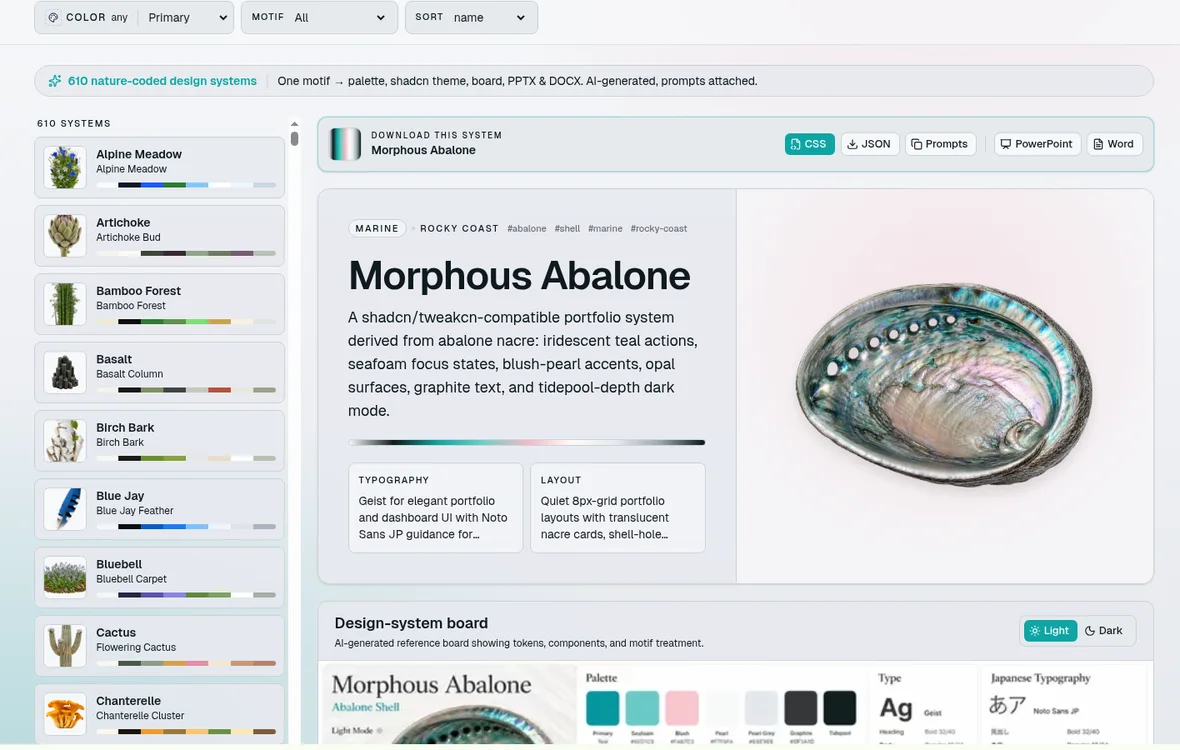 Morphos gallery screen, with download options for CSS, JSON, prompts, PowerPoint, and Word.
The main download formats are:
AI-ready color palette
A format you can paste directly into ChatGPT or Claude. Add one sentence like "build the UI with this palette" and the model gets concrete color direction instead of a vague mood.
For example, when asking an AI model to create a chat UI, I used to describe the direction in vague language: "make it fresh with blue tones, but give it a bit of edge." With Morphos, I can paste a list of color codes and make the direction clear immediately.
Outsource the color decision so you can spend more time on the content, structure, and product itself. Morphos is a tool for that shift.
Use Cases
I designed Morphos for situations like these:
- Color direction when asking AI to build UI or UX
- Palette templates for presentations, proposals, and internal documents
- Inspiration for personal projects and branding
It is especially useful when prompting AI. By replacing vague words like "nice" or "stylish" with a nature motif and concrete color codes, the generated output becomes much easier to steer.
Technologies Used
The implementation is centered around two tools:
- Codex: the main driver for coding and implementation
- ChatGPT Images 2.0: generation of the natural motif visuals
The pipeline generates nature-inspired visuals, extracts palettes from them, and expands those palettes into CSS, PowerPoint, and Word outputs. One of the interesting parts of current development is that AI is not only a tool for writing code. It can also generate the raw visual material that a product is built from.
Source Code Is on GitHub
The prompts used for image generation, the color extraction flow, and the skills and scripts for converting palettes into each format are all public on GitHub.
GitHub: Ameyanagi/morphos
If you want to build a similar collection or adapt the pipeline to another theme, the repository should be a useful reference.
If you like the project, a GitHub Star would be very appreciated.
Closing
There are many color palette collections already. Morphos is different because of the combination: nature-only sources, packaged for AI-first usage.
Spend less time choosing colors, and more time thinking about the substance of what you are making. Take a look at the site, and if you find a palette you like, you should be able to use it in tomorrow's slides or coding session.
Feedback and requests for new motifs are welcome.